
China’s New Exit-Entry Law and Implementing Regulation
Introduction
As a result of the deliberations of the standing committee of the National People’s Congress on June 30th 2012, a new exit-entry law came into effect on July 1st 2013. This replaces a pair of existing laws, one for Chinese nationals and one for foreigners, unchanged since the eighties and seen by many to be in need of a significant overhaul. Order 637, resulting from the 15th standing committee (July 3rd 2013) and due to take effect on September 1st 2013, provides implementation rules for the aforementioned law. Both documents introduce their own novelties, and we shall look into some key concepts and changes from each one separately.
Key Changes – New Law
– The law introduces a new visa category, namely ‘talent introduction’, for foreign experts deemed by China to be urgently needed (see R-visa in next section).
– For all such offences that require deportation, and are deemed sufficiently serious, a 10-year travel ban to China will be imposed. The decision to deport rests with the responsible Public Security Bureau (PSB) and cannot be appealed. Lesser travel bans and voluntary departures are also available for lesser offences. In general, the new law signifies an era of more severe punishments for offences covered by its scope.
– For several offences, a system of fines is detailed. A person staying illegally will be fined RMB 500 per day (not exceeding RMB 10 000 in total) and may be detained anywhere from 5 to 15 days. With regard to illegal employment, the fine for the employer will be RMB 10 000 per illegal employee (not exceeding RMB 100 000). Illegal earnings will be confiscated and both the employee and the person/organisation who introduced him or her to the work (thus encouraging the illegal activity) are liable for RMB 5000 – 20 000 and RMB 5000 per person introduced (not exceeding RMB 50 000) respectively. What constitutes the illegal employment of foreigners is detailed in the law, and includes (but is not limited to) working without a work permit or beyond its scope.
– Apart from the usual reasons, detailed in pre-existing laws (such as a decision of a People’s Court to this effect for unsettled civil cases), aliens will not be allowed to leave China should they default on payments to workers and if a decision to this effect is taken by a relevant government office (see Article 28 for a list of these).
– A residence permit or certificate obtained for employment purposes can have a validity anywhere between 90 days and 5 years (the minimum used to be 180 days). A residence permit obtained for purposes unrelated to employment can have a validity anywhere between 180 days and 5 years.
– Employers must now report the foreigners they recruit to the relevant PSB. There is a general obligation for all to report those who are working (or staying, or entering) illegally.
– Aliens applying for the above permit will now have to provide some biometric information. The law gives the example of fingerprints.
– Security organs are allowed to forbid foreigners from establishing residences or workplaces in certain areas, requiring those already established to move.
– The visa issuing office is not required to provide a reason for denying a visa to an alien, and no appeal route is provided. This level of discretion had yet to be sanctioned by law.
– Under article 47, aliens having made, among other things, ‘outstanding contributions’ to China’s development may qualify for permanent residence.
– The law recognises, and makes provisions for, those who apply for or are granted with the status of refugee.
Key Changes – Implementing Regulation
The summaries of the types of ordinary visas, as listed in the implementing rules, are given here together with how they compare to their pre-01/09/2013 counterparts.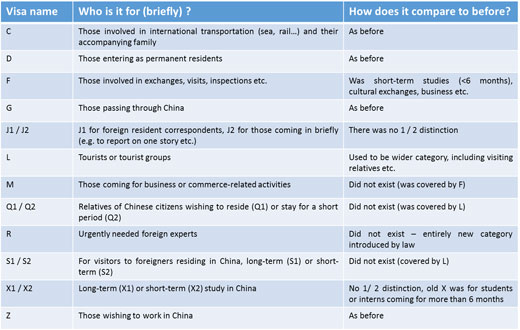
The implementing rules also provide an outline for the application process for each type of visa. For example, one must provide the required work permit for a Z-visa (and other related documents). For an R-visa, the documents from a relevant Chinese authority expressing its need for said expert must be provided. Unpaid foreign staff may use an F or M-visa, whereas any paid employment would come under the scope of a Z-visa. The types of residency certificates or permits available are also briefly detailed below.
It is also worth noting that:
– The extension of a visa cannot exceed the time in China that was granted in the original visa. The visa type cannot be changed however (in other words, one may not change an F-visa to M-visa during their stay, though they may extend their F-visa should they wish to).
– A visa expires at midnight Beijing time on the provided expiry date.
– An R-visa for foreigners above 60 years old will be issued on a case by case basis and may require, for approval, additional documentation
Conclusion
It appears many of these changes have come to strengthen the crackdown on immigration-related offences. Punishments are stricter, and more numerous than before. As for the implementing rules, the only great novelty is the R-visa, which will smoothen the way for China’s use of foreign talent. Other categories seem to only be introduced to make the system, in general, more specific. In other words, categories used to be wider in both scope (ie each one being available for many purposes) and time (ie fewer distinctions relating to length of stay were available).
LehmanBrown is glad to provide advice on work permits, residency visas for employees and family members and many business-related matters to accompany you through these procedures pursuant to the regulations of Chinese government authorities. If you would like more details, do not hesitate to get in touch with one of our professionals.